Thursday, 24 September 2015

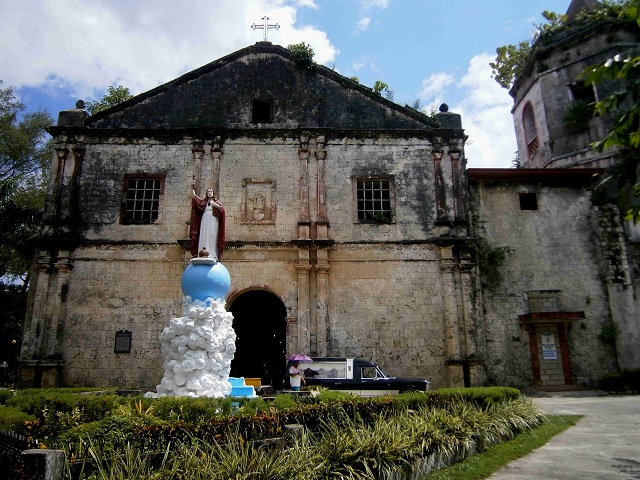
Parroquia de la Santa Cruz, Maribojoc, Bohol


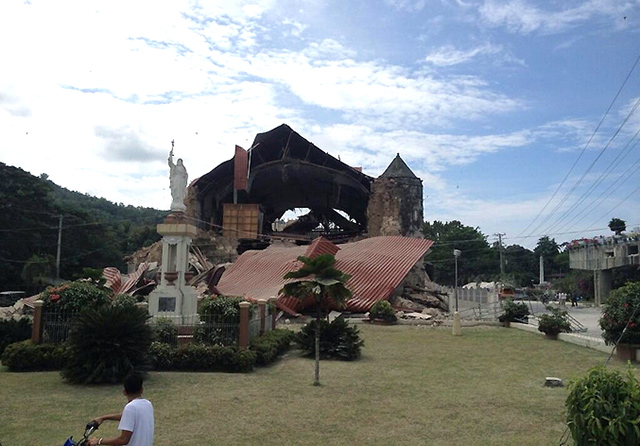
The Maribojoc church was also  built in the 19th century by the Jesuit order.
The parish of Maribojoc, Bohol was founded in 1768, and construction of a church started 1798 and lasted 18 years. The Santa Cruz Parish Church (Church of the Holy Cross) is located in the poblacion of Maribojoc 14 km (8.7 mi) from the Tagbilaran.
Maribojoc began as a Jesuit mission in the 18th century. The Jesuits built a temporary church, which the Recollects replaced with the present structure by 1886.
Unlike other churches, the convent of Maribojoc is located behind the church rather than adjacent. This gives the convent an unobstructed view of the sea, especially from the balcony that runs the length of the structure. It is approached through the sacristy and is a continuation of the convent. Above the sacristy is a room which has been converted to the Maribojoc museum.
The church had a cruciform ground plan. Its façade was plain, decorated by thin pilasters and niches with images of saints. The interior had three Neogothic altars. The traceries andfinials of gilded hardwood are delicately carved. The main altar has an image of the Blessed Trinity and bas-reliefs of the life of Mary Magdalene. The church ceiling is made of metal and painted with catechetical and liturgical motifs
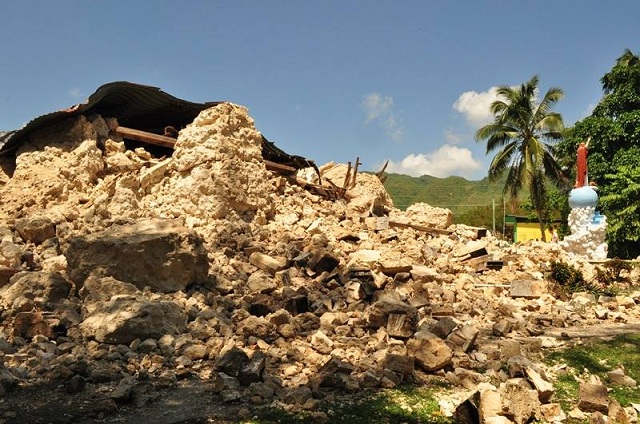
The 1886 Maribojoc Church crumbled to the ground entirely during the 2013 Bohol earthquake.


http://www.gmanetwork.com/news/story/330979/lifestyle/artandculture/from-treasure-to-rubble-heritage-churches-before-and-after-the-bohol-quake

http://en.wikipedia.org/wiki/Roman_Catholic_churches_in_Bohol


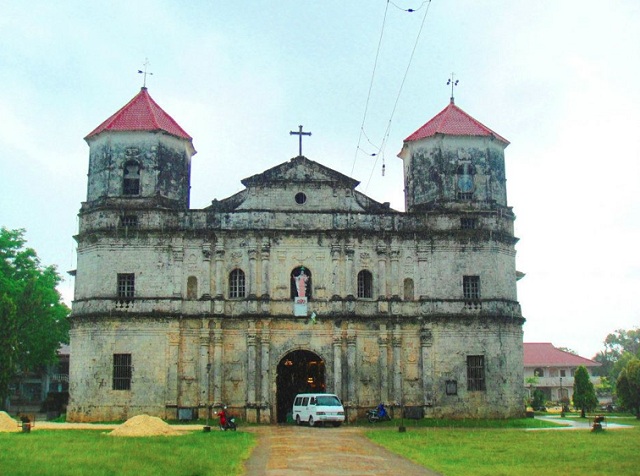
Nuestra Señora de la Luz, Loon, Bohol


The last church building built between 1855-1864 was the biggest church in Bohol before it was completely destroyed by the earthquake of October 15, 2013.
The parish of Loon was established by the Jesuits in 1753 under the curacy of Fray Manuel de Elizalde. The Jesuits built the first church along the shore in Barangay Napo. TheAugustinian Recollects took charge of the town in 1768 following the expulsion of the Jesuits from the Spanish Empire. The first Recollects in Loon described the Jesuit-built church as a shed of wooden posts with a roof of nipa, in bad condition; the convent was not much better.  They transferred the town center and church to its present location on a plateau about fifty meters or more above the shore level. A four-flight stairway of 174 stone steps built by the Recollects connects it to Napo, the former seat of the town; a watchtower near the topmost landing serves as lookout tower for pirates. The Recollects built a church c. 1812 that burned down in the 1850s leaving just the front of the church. They began rebuilding the church in 1855. Wood to build the church was carried from the forest of Maitum by forced laborers, who had to beat their way through uncharted trails and across rivers.

This coral-stone church was seen as one of the grandest and finest churches in Visayas, and was also the biggest in Bohol. The Augustinian Recollects constructed the current church in Ionic and Corinthian style, and its facade was known for its symmetry.


After the quake, Loon residents were met with the devastating sight of their old church pulverized, reduced to a pile of rubble with no structure left at all.

View image on Twitter

The town of Loon in Bohol was one of the areas most affected by the magnitude 7.2 earthquake that shook the province and nearby areas on Tuesday morning.


http://www.gmanetwork.com/news/story/330979/lifestyle/artandculture/from-treasure-to-rubble-heritage-churches-before-and-after-the-bohol-quake
http://en.wikipedia.org/wiki/Roman_Catholic_churches_in_Bohol#Loon

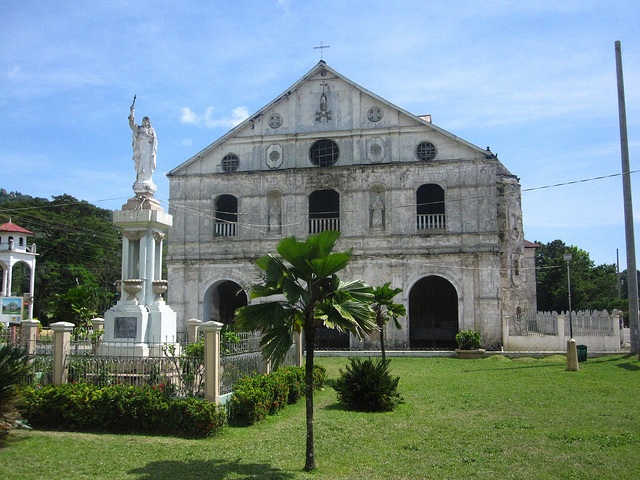
San Pedro Church, Loboc - Bohol Churches


 is the second oldest church established in Bohol. It was originally built in 1602, but was soon reduced to ashes. In 1638, a stronger replacement was built. Located near the river, it has survived a number of floods. Inside the church, there are some remarkable frescoes on the ceiling. A Spanish coat-of-arms can be found in the stone wall near the entrance of the convent. The bell tower of Loboc is about 100 m (330 ft) across the street from the church. Attached to the building is a three storey convent, which today houses the Museo de Loboc (Loboc Museum) on the third floor. This museum houses a few old statues of saints, and some other antique religious artifacts. In Loboc, you can also admire a shameful witness of wasteful government planning. Exactly next to the church is a partly finished bridge across the river. The bridge was never finished as it involves the removal of the Church to be completed.

The Loboc church is decorated with carvings of cherubs, the Papal tiara and emblems of the Jesuit. It has two facades: the Jesuit-built Baroque façade decorated with unfinished medallions depicting saints and the Neoclassical portico added by the Recollects. Although main altar is Neoclassical, two side altars are Baroque and two at the transept ends are put together from several parts, creating a syncretic style. Many of the saints of Jesuit devotion have been replaced by saints of Recollect devotion except for the image of Saint Francis Xavier found at the side altar to the right of the main altar. Also, hidden by the main altar, is a bas relief of Saint Ignatius and Saint Francis Xavier done in stucco.

According to the NCCA website, this church was built in the 17th century by the Jesuits. The Augustinian Recollects added the porticos and funeral chapel in the 19th century. It was also decorated with paintings in the 20th century.

San Pedro Church in Loboc before the earthquake. Ederic Eder
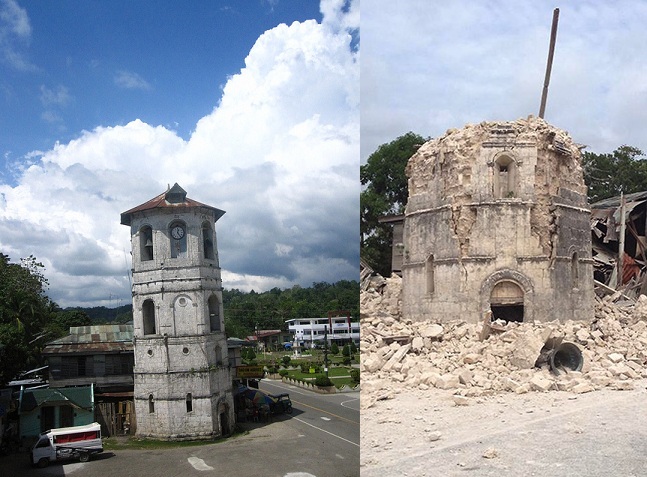
The earthquake brought down parts of the ceiling and walls of Bohol's second oldest church. The facade has collapsed entirely and the bell tower (below) has been halved in height.


San Pedro Church Tuesday morning. Robert Michael Poole via Twitter

The kampanaryo (bell tower) before and after. Ederic Eder/Robert Michael Poole


Wednesday, 17 June 2015

The Art of Making Burnay: Vigan, Ilocos Sur, Philippines


BY 


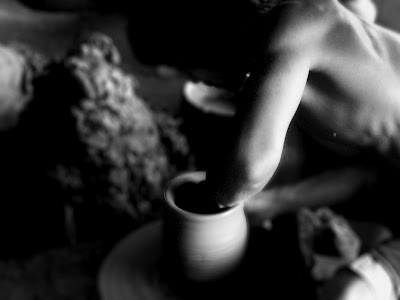
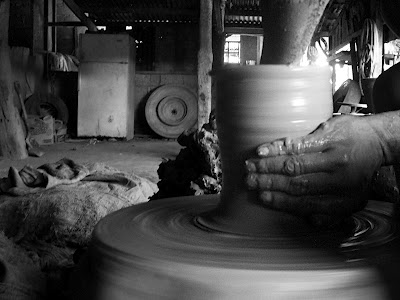
Potter of burnay jar. Photo credit Jay Javier http://eastofherewestofthere.blogspot.com
Potter of burnay jar.
Photo credit Jay Javier http://eastofherewestofthere.blogspot.com
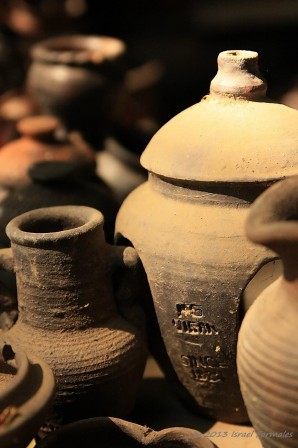
As Vigan is known for its historic ancestral houses that illustrate a fusion of architecture from Spanish colonial time with Asian influences, the people of Vigan also exert great effort to preserve the tradition of making “burnay”. Burnay is unglazed earthen jars, an industry that dates back to pre-colonial times when immigrants from China came and settled in Vigan. Burnay jars have small openings, and its earlier use were for tea drinking, storage for water, rice grains and as container for salt, brown sugar, local wine (basi) and bagoong (fermented fish). It is even said that basi and bagoong taste much better when stored inside burnays.  Burnay jars are also utilized in fermentation of vinegar that comes from the sweet sap of the Arenga Pinnata, a sugar palm tree more commonly known as “kaong.”
Burnay jars Photo credit: Israel Formales
Burnay jars
Photo credit: Israel Formales
for http://www.themixedculture.com
These earthenware jars are crafted by a potter’s skillful hands with a help of potter’s wheel and a kiln. The potter uses a grade A clay that is widely available in the western area of Vigan. Fine sand is used as a tempering material to achieve the desired shape, afterwards, it will be placed inside a high-temperature ground kiln made of brick and clay.  Because of this, people say that burnay jars are harder and durable compared to terra cotta.
The art and technology of making burnays were brought to Vigan by Chinese artisans. For which, the art of making burnays existed in the area of Vigan right before the Spaniards came in 1572. These Chinese artisans, who built this industry relied on the locals of Vigan for their clay and labor.  The industry of making burnays prosper in 1890, when Pedro Go, a Chinese settler from Chinkang, in Fukien, Mainland China set-upped his camarin (jar factory) along what is now known as Rivero Street in Brgy. VIII. Later on around 1916, Ongkai Go, son of Pedro Go’s brother, came to the Philippines and worked with him, however, Ongkai went back to China to get marry when he was 18 years old.
   Ongkai went back to the Philippines in 1922, and together with his cousin Igan Go, they built their own jar factory known until today as Ruby Pottery. Years later, the son of the late Ongkai, Fidel Go, inherited the factory from Igan Go. Continuing the tradition of the craft inherited and preserving the art of making burnays, Fidel Go was awarded with the Gawad Manlilikha ng Bayan (National Folk Artist Award) of the National Commission on Culture and the Arts in 1990.
Potter of burnay jar. Photo credit Jay Javier http://eastofherewestofthere.blogspot.com
Potter of burnay jar.
Photo credit Jay Javier http://eastofherewestofthere.blogspot.com
As of today, there are, three (3) “burnay” factories remain: RG Jar Factory, Ruby Pottery, and NP Jar Factory. These “burnay” factories are the only ones found throughout the country.  Nowadays, varieties of burnay jars are made, mostly for decorative purposes. People buy them mostly to serve as decorations inside their homes and gardens. Burnay jars are also sought-after by foreign and local tourists. It has reached the markets abroad, especially in Europe. Foreign and local traders made contact with burnay factory owners to order not only the traditional designs of burnay but as well according to their preferences. Through these continuous demands of earthen jars, it has sustained the livelihood of many Chinese and Fil-Chinese generations who own burnay factories or camarin, and most importantly the preservation of the craft. The art of making burnay stood the test of time and continues to showcase Filipinos artistry and craftsmanship. Highly quality products and preserved tradition: Burnay jars of Vigan, Ilocos Sur.
Photo disclaimer: The Mixed Culture does not own the photo(s) used in this post, however, proper permission to use the photo(s) above was given to The Mixed Culture. Unauthorized use and/or duplication of any photo(s) without express and written permission from the artist and/or owner is strictly prohibited. For any photo related interest, please contact the artist directly by visiting the webpage provided or leave us a message.

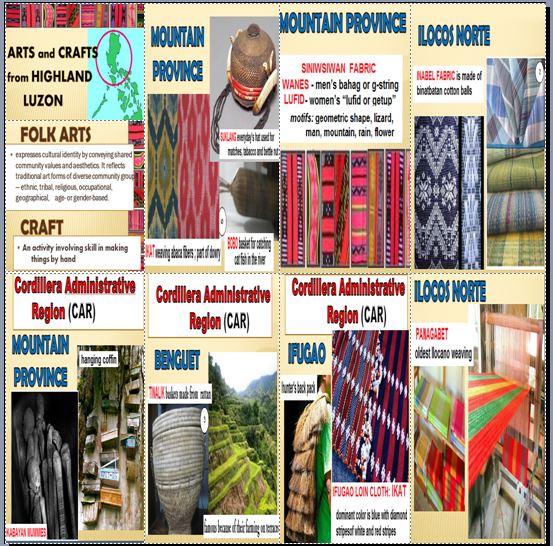
Bul - ul and Taka: Folk Arts of Luzon


Reference Wikipedia.com

Saturday, 1 November 2014

OKIR MAKING ACTIVITY


OKIR MAKING ACTIVITY


OBJECTIVES


1. Draw OKIR designs of scrolls and geometric designs
2. Recognize the importance of these designs to indigenous Muslim Art forms
3. Apply the knowledge of the elements and principles of art in making the designs

MATERIALS

Pictures or Real samples of some Maranao art, sarimanok, naga, okir ornaments, malong, oslo paper or bond paper, coloring materials (crayon or watercolor)

Procedure

1. Look at the visuals of okir carefully. observe the elements of art - lines, forms, textures, and colors featured in these designs.

2. Choose one and draw: Okir a datu or Okir a bay

3. If you choose okir a datu practice drawing scrolls, leaves, or flower motifs. Observe balance, rhythm, and other principles of art.

4. If you choose okir a bay, practice drawing geometric designs like those found in the malong.

5. Finalize your work on a sheet of Oslo paper or bond paper

6. Copy and answer the rubric of okir a datu and okir a bay on a separate sheet of paper


Rubric for Drawing of 
OKIR A DATU OR OKIR A BAY

Name ________________________________________
Put a Check on the column that indicates your answer

CRITERIA               ALWAYS  OFTEN  SOMETIMES  SELDOM SCORE   TEACHER'S SCORE
                                           4 PTS       3                 2                   1

 Meeting the general 
    expressions

     1. Artwork is of
         appropriate size
     2. Work is neat, clear
         and complete
         handed on time
     3. Directions are
         followed

  Used the Art elements 

     4. Line
     5. Color
     6. Shape
     7. Form

  Principles of designs

     8. Balance
     9. Rhythm
    10. Contrast
    11. Movement

  Shows Creativity
   
    12. Shows originality
    13. Pleasing to
           look at
    14. Shows definite
         characteristics of
         okir a datu
    15.  Shows definite
         characteris of
         okir a bay

The highest possible score is 60 points

Rating of artworks

Always : 46-60 = 90%
Often    : 31-45 = 85%
Sometimes: 16-30 = 80%
Seldom     : 1-15 = 75 

Questions for discussion

1. Which okir design is easier to draw? Why?
2. How did the activity help you appreciate Maranao's art style?
3. What values did you learn from the okir design-making activity?